The term internet.
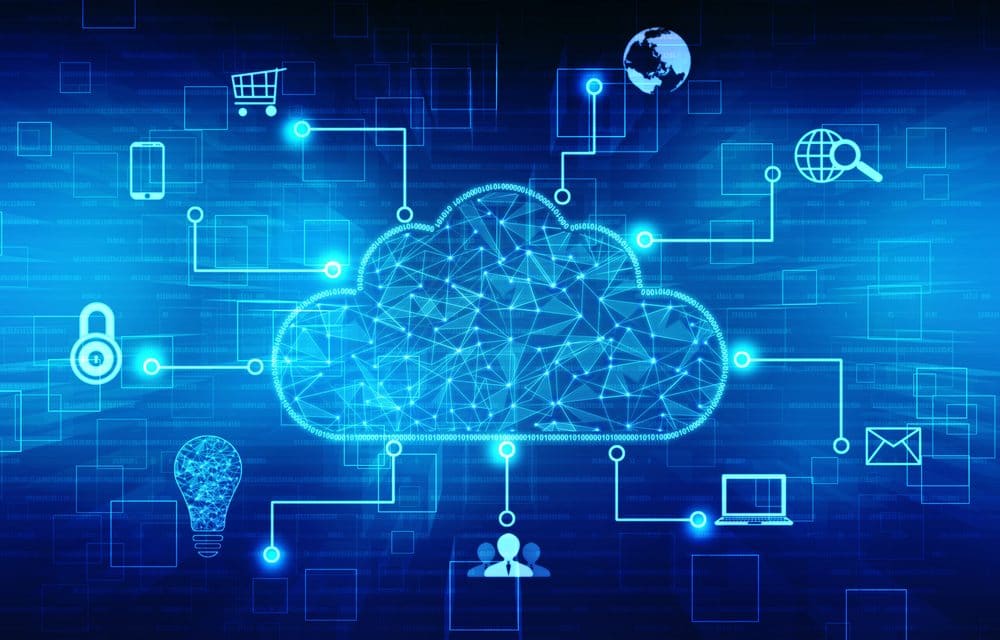
The Internet (contraction of interconnected network) is the global system of interconnected computer networks that use the Internet protocol suite (TCP/IP) to link devices worldwide. It is a network of networks that consists of private, public, academic, business, and government networks of local to global scope, linked by a broad array of electronic, wireless, and optical networking technologies. The Internet carries a vast range of information resources and services, such as the inter-linked hypertext documents and applications of the World Wide Web (WWW), electronic mail, telephony, and file sharing. Some publications no longer capitalize “internet”.
The history of internet?
The history of the Internet begins with the development of electronic computers in the 1950s. Initial concepts of wide area networkingoriginated in several computer science laboratories in the United States, United Kingdom, and France.[The U.S. Department of Defense awarded contracts as early as the 1960s, including for the development of the ARPANET project, directed by Robert Taylor and managed by Lawrence Roberts. The first message was sent over the ARPANET in 1969 from computer science Professor Leonard Kleinrock’s laboratory at University of California, Los Angeles (UCLA) to the second network node at Stanford Research Institute (SRI).
Packet switching networks such as the NPL network, ARPANET, Merit Network, CYCLADES, and Telenet, were developed in the late 1960s and early 1970s using a variety of communications protocols.[Donald Davies first demonstrated packet switching in 1967 at the National Physics Laboratory (NPL) in the UK, which became a testbed for UK research for almost two decades.[ The ARPANET project led to the development of protocols for internetworking, in which multiple separate networks could be joined into a network of networks
How does internet work?
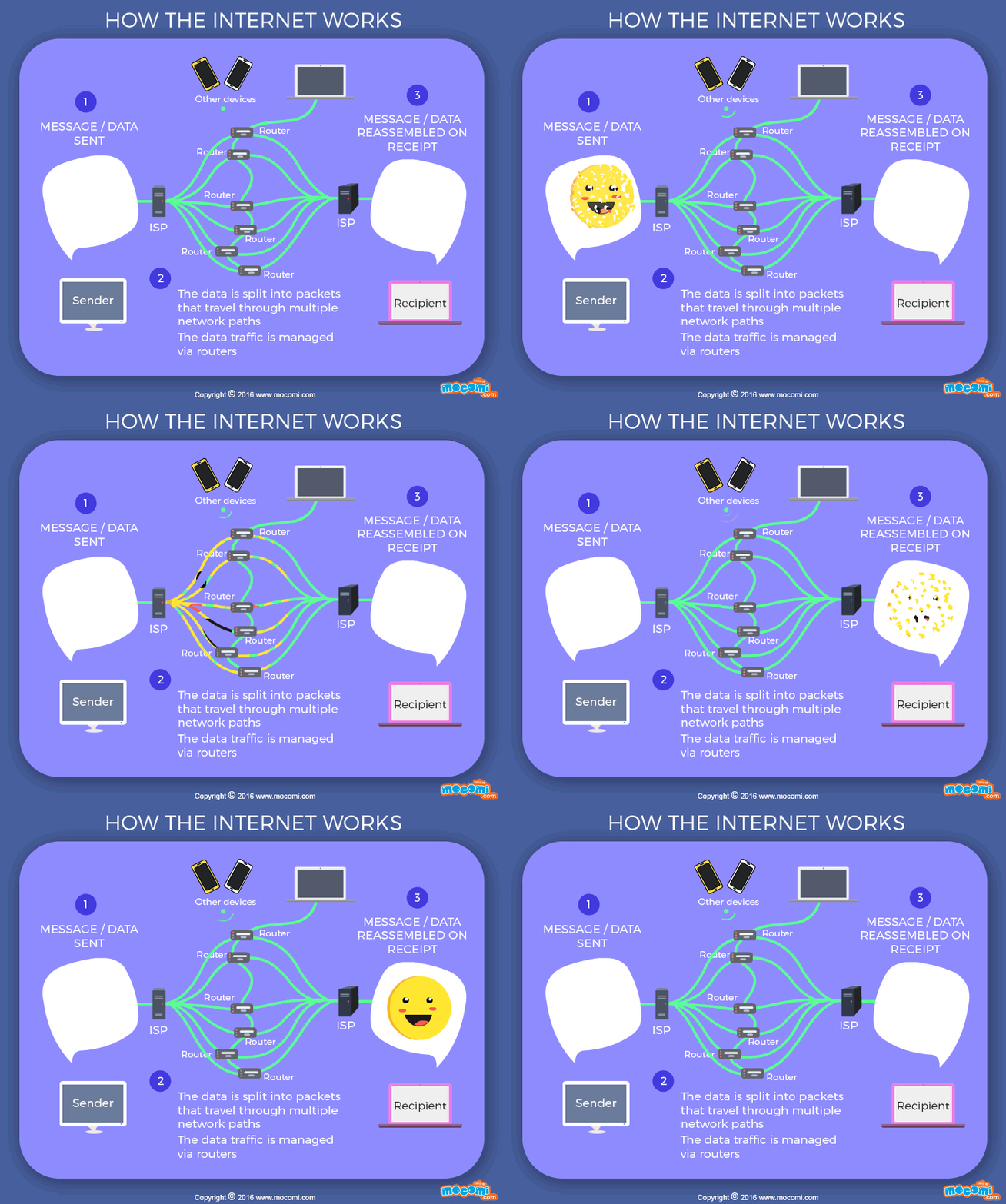
Other types of hardware that support the Internet include routers, servers, cell phone towers, satellites, radios, smartphones and other devices. All these devices together create the network of networks. The Internet is a malleable system — it changes in little ways as elements join and leave networks around the world. Some of those elements may stay fairly static and make up the backbone of the Internet. Others are more peripheral.
These elements are connections. Some are end points — the computer, smartphone or other device you’re using to read this may count as one. We call those end points clients. Machines that store the information we seek on the Internet are servers. Other elements are nodes which serve as a connecting point along a route of traffic. And then there are the transmission lines which can be physical, as in the case of cables and fiber optics, or they can be wireless signals from satellites, cell phone or 4G towers, or radios.
All of this hardware wouldn’t create a network without the second component of the Internet: the protocols. Protocols are sets of rules that machines follow to complete tasks. Without a common set of protocols that all machines connected to the Internet must follow, communication between devices couldn’t happen. The various machines would be unable to understand one another or even send information in a meaningful way. The protocols provide both the method and a common language for machines to use to transmit data.
Uses of internet?
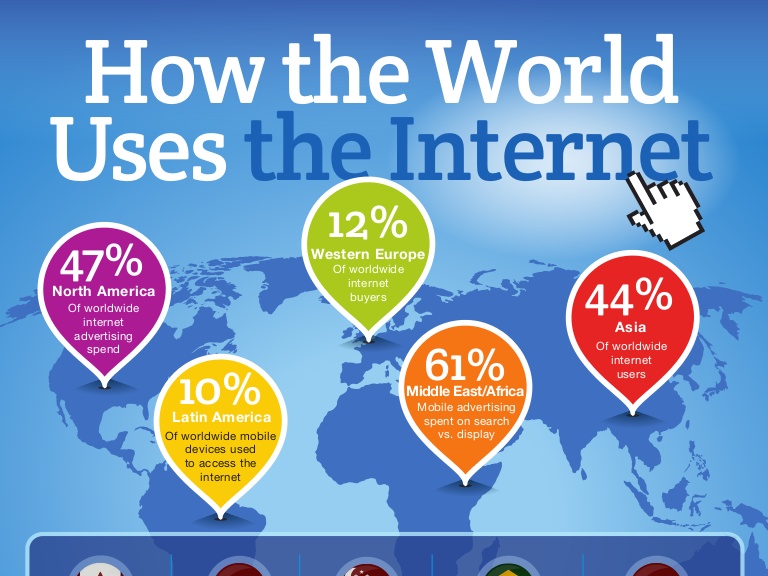
Uses of the Internet in our daily life is depending on desires and goals. Activities in our daily life are decided after the use of Internet. Internet innovated our daily life. We spend lot’s of time on the Web.
Positive use of the Internet makes our lives easy and simple. The Internet provides us useful data, information, and knowledge for the personal, social and economic development and it is up to us to utilize our time on the worldwide web in a productive manner. The Internet is a revolution in information technology.
While there are various uses of the Internet but you can use the internet for getting an online education. You can use the Internet to promote your business online.
You can do online courses and improve your writing, communication, business and online marketing skills. Online shopping, social media, emails, chatting are common things that we do daily.
You are free to use the Internet. The Internet is a magical tool that will help you to become successful in your career and business. But only the positive and productive use of the Internet.
World wide web (WWW)
The World Wide Web (WWW), commonly known as the Web, is an information space where documents and other web resources are identified by Uniform Resource Locators (URLs, such as https://www.example.com/), which may be interlinked by hypertext, and are accessible over the Internet.[ The resources of the WWW may be accessed by users by a software application called a web browser.
English scientist Tim Berners-Lee invented the World Wide Web in 1989. He wrote the first web browser in 1990 while employed at CERN near Geneva, Switzerland. The browser was released outside CERN in 1991, first to other research institutions starting in January 1991 and then to the general public in August 1991. The World Wide Web has been central to the development of the Information Age and is the primary tool billions of people use to interact on the Internet.[
Web resources may be any type of downloaded media, but web pages are hypertext media that have been formatted in Hypertext Markup Language (HTML). Such formatting allows for embedded hyperlinks that contain URLs and permit users to navigate to other web resources. In addition to text, web pages may contain images, video, audio, and software components that are rendered in the user’s web browser as coherent pages of multimedia content.
Multiple web resources with a common theme, a common domain name, or both, make up a website. Websites are stored in computers that are running a program called a web server that responds to requests made over the Internet from web browsers running on a user’s computer. Website content can be largely provided by a publisher, or interactively where users contribute content or the content depends upon the users or their actions. Websites may be provided for a myriad of informative, entertainment, commercial, governmental, or non-governmental reasons.
A website[ or Web site is a collection of related network web resources, such as web pages, multimedia content, which are typically identified with a common domain name, and published on at least one web server. Notable examples are wikipedia.org, google.com, and amazon.com.
Websites can be accessed via a public Internet Protocol (IP) network, such as the Internet, or a private local area network (LAN), by a uniform resource locator (URL) that identifies the site.
An Internet Protocol address (IP address) is a numerical label assigned to each device connected to a computer network that uses the Internet Protocol for communication. An IP address serves two principal functions: host or network interface identification and location addressing.
Internet Protocol version 4 (IPv4) defines an IP address as a 32-bit number. However, because of the growth of the Internet and the depletion of available IPv4 addresses, a new version of IP (IPv6), using 128 bits for the IP address, was developed in 1995, and standardized in December 1998. In July 2017, a final definition of the protocol was published.[ IPv6 deployment has been ongoing since the mid-2000s.
IP addresses are usually written and displayed in human-readable notations, such as 172.16.254.1 in IPv4, and 2001:db8:0:1234:0:567:8:1 in IPv6. The size of the routing prefix of the address is designated in CIDR notation by suffixing the address with the number of significant bits, e.g., 192.168.1.15/24, which is equivalent to the historically used subnet mask 255.255.255.0.
The IP address space is managed globally by the Internet Assigned Numbers Authority (IANA), and by five regional Internet registries (RIRs) responsible in their designated territories for assignment to end users and local Internet registries, such as Internet service providers. IPv4 addresses have been distributed by IANA to the RIRs in blocks of approximately 16.8 million addresses each. Each ISP or private network administrator assigns an IP address to each device connected to its network. Such assignments may be on a static (fixed or permanent) or dynamic basis, depending on its software and practices.
E – mail
Electronic mail (email or e-mail) is a method of exchanging messages (“mail”) between people using electronic devices. Invented by Ray Tomlinson, email first entered limited use in the 1960s and by the mid-1970s had taken the form now recognized as email. Email operates across computer networks, which today is primarily the Internet. Some early email systems required the author and the recipient to both be online at the same time, in common with instant messaging. Today’s email systems are based on a store-and-forward model. Email serversaccept, forward, deliver, and store messages. Neither the users nor their computers are required to be online simultaneously; they need to connect only briefly, typically to a mail server or a webmail interface for as long as it takes to send or receive messages.
Originally an ASCII text-only communications medium, Internet email was extended by Multipurpose Internet Mail Extensions (MIME) to carry text in other character sets and multimedia content attachments. International email, with internationalized email addresses using UTF-8, has been standardized, but as of 2017 it has not been widely adopted.[
The history of modern Internet email services reaches back to the early ARPANET, with standards for encoding email messages published as early as 1973 (RFC 561). An email message sent in the early 1970s looks very similar to a basic email sent today. Email had an important role in creating the Internet,[and the conversion from ARPANET to the Internet in the early 1980s produced the core of the current services.

E commerce
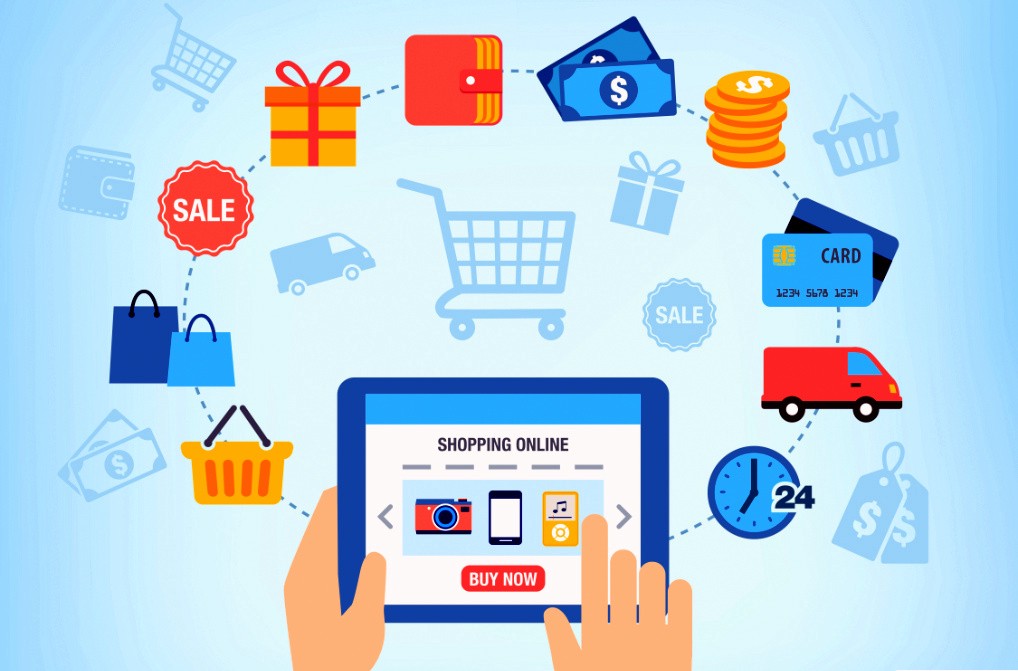
E-commerce is the activity of buying or selling of products on online services or over the Internet. Electronic commerce draws on technologies such as mobile commerce, electronic funds transfer, supply chain management, Internet marketing, online transaction processing, electronic data interchange (EDI), inventory management systems, and automated data collection systems.
Modern electronic commerce typically uses the World Wide Web for at least one part of the transaction’s life cycle although it may also use other technologies such as e-mail. Typical e-commerce transactions include the purchase of online books (such as Amazon) and music purchases and to a less extent, customized/personalized online liquor store inventory services.]There are three areas of e-commerce: online retailing, electric markets, and online auctions. E-commerce is supported by electronic business.
E-commerce businesses may also employ some or all of the followings:
- Online shopping for retail sales direct to consumers via Web sites and mobile apps, and conversational commerce via live chat, chatbots, and voice assistants[
- Providing or participating in online marketplaces, which process third-party business-to-consumer or consumer-to-consumer sales
- Business-to-business buying and selling;
- Gathering and using demographic data through web contacts and social media
- Business-to-business (B2B) electronic data interchange
- Marketing to prospective and established customers by e-mail or fax (for example, with newsletters)
- Engaging in pretail for launching new products and services
- Online financial exchanges for currency exchanges or trading purposes.
M commerce
Mobile money transfer
In Kenya money transfer is mainly done through the use of mobile phones. This was an initiative of a multimillion shillings company in Kenya named Safaricom. Currently, the companies involved are Safaricom and Airtel. Mobile money transfer services in Kenya are now provided by the two companies under the names M-PESA and Airtel Money respectively.
A similar system called MobilePay has been operated by Danske Bank in Denmark since 2013. It has gained considerable popularity with about 1.6 million users by mid-2015. Another similar system called Vipps was introduced in Norway in 2015.
Mobile automated teller machine (ATM) is a special type of ATM. Most ATMs are meant to be stationary, and they’re often found attached to the side of financial institutions, in stores, and in malls. A mobile ATM machine, on the other hand, is meant to be moved from location to location. This type of ATM is often found at special events for which ATM service is only needed temporarily. For example, they may be found at carnivals, fairs, and parades. They may also be used at seminars and workshops when there is no regular ATM nearby.
Mobile ATMs are usually self-contained units that don’t need a building or enclosure. Usually, a mobile ATM can be placed in just about any location and can transmit transaction information wirelessly, so there’s no need to have a phone line handy. Mobile ATMs may, however, require access to an electrical source, though there are some capable of running on alternative sources of power. Often, these units are constructed of weather-resistant materials, so they can be used in practically any type of weather conditions. Additionally, these machines typically have internal heating and air conditioning units that help keep them functional despite the temperature of the environment.ion of mobile money services for the unbanked, operators are now looking for efficient ways to roll out and manage distribution networks that can support cash-in and cash-out. Unlike traditional ATM, sicap Mobile ATM have been specially engineered to connect to mobile money platforms and provide bank grade ATM quality. In Hungary, Vodafone allows cash or bank card payments of monthly phone bills.[ The Hungarian market is one where direct debits are not standard practice, so the facility eases the burden of queuing for the postpaid half of Vodafone’s subscriber base in Hungary.
Mobile ticketing
Tickets can be sent to mobile phones using a variety of technologies. Users are then able to use their tickets immediately, by presenting their mobile phone at the ticket check as a digital boarding pass. Most numbers of users are now moving towards this technology. Best example would be IRCTC where ticket comes as SMS to users. New technology such as RFID can now be used to directly provide a single association digital ticket via the mobile device hardware associated with relevant software.
Mobile vouchers, coupons and loyalty cards
Mobile ticketing technology can also be used for the distribution of vouchers, coupons, and loyalty cards. These items are represented by a virtual token that is sent to the mobile phone. A customer presenting a mobile phone with one of these tokens at the point of sale receives the same benefits as if they had the traditional token. Stores may send coupons to customers using location-based services to determine when the customer is nearby. Using a connected device and the networking effect can also allow for gamification within the shopping experience.
Content purchase and delivery
Currently, mobile content purchase and delivery mainly consist of the sale of ring-tones, wallpapers, apps, and games for mobile phones. The convergence of mobile phones, portable audio players, and video players into a single device is increasing the purchase and delivery of full-length music tracks and video. The download speeds available with 4networks make it possible to buy a movie on a mobile device in a couple of seconds.
The location of the mobile phone user is an important piece of information used during mobile commerce or m-commerce transactions. Knowing the location of the user allows for location-based services such as:
- Local discount offers
- Local weather
- Tracking and monitoring of people
- Data driven mashups targeting at a hyper-local level
Information services
A wide variety of information services can be delivered to mobile phone users in much the same way as it is delivered to PCs. These services include:
News
Stock quotes
Sports scores
Financial recordsT
Traffic reporting
Emergency Alerts
Location based notifications
Customized traffic information, based on a user’s actual travel patterns, can be sent to a mobile device. This customized data is more useful than a generic traffic-report broadcast, but was impractical before the invention of modern mobile devices due to the bandwidth requirements.
Mobile banking
Banks and other financial institutions use mobile commerce to allow their customers to access account information and make transactions, such as purchasing stocks, remitting money. This service is often referred to as mobile banking, or m-banking.
Mobile brokerage
Stock market services offered via mobile devices have also become more popular and are known as Mobile Brokerage. They allow the subscriber to react to market developments in a timely fashion and irrespective of their physical location.
Auctions
Over the past three years mobile reverse auction solutions have grown in popularity.[bUnlike traditional auctions, the reverse auction (or low-bid auction) bills the consumer’s phone each time they place a bid. Many mobile SMS commerce solutions rely on a one-time purchase or one-time subscription; however, reverse auctions offer a high return for the mobile vendor as they require the consumer to make multiple transactions over a long period of time.
Mobile browsing
Using a mobile browser—a World Wide Web browser on a mobile device—customers can shop online without having to be at their personal computer. Many mobile marketing apps with geo-location capability are now delivering user-specific marketing messages to the right person at the right time.
Mobile purchase
Catalog merchants can accept orders from customers electronically, via the customer’s mobile device. In some cases, the merchant may even deliver the catalog electronically, rather than mailing a paper catalog to the customer. Consumers making mobile purchases can also receive value-add upselling services and offers. Some merchants provide mobile web sites that are customized for the smaller screen and limited user interface of a mobile device.
In-application mobile phone payments
Payments can be made directly inside of an application running on a popular smartphone operating system, such as Google Android. Analyst firm Gartner expects in-application purchases to drive 41 percent of app store (also referred to as mobile software distribution platforms) revenue in 2016. In-app purchases can be used to buy virtual goods, new and other mobile content and is ultimately billed by mobile carriers rather than the app stores themselves. Ericsson’s IPX mobile commerce system is used by 120 mobile carriers to offer payment options such as try-before-you-buy, rentals and subscriptions.[
In the context of mobile commerce, mobile marketing refers to marketing sent to mobile devices. Companies have reported that they see better response from mobile marketing campaigns than from traditional campaigns. The primary reason for this is the instant nature of customer decision-making that mobile apps and websites enable. The consumer can receive a marketing message or discount coupon and, within a few seconds, make a decision to buy and go on to complete the sale – without disrupting their current real-world activity.
For example, a busy mom tending to her household chores with a baby in her arm could receive a marketing message on her mobile about baby products from a local store. She can and within a few clicks, place an order for her supplies without having to plan ahead for it. No more need to reach for her purse and hunt for credit cards, no need to log into her laptop and try to recall the web address of the store she visited last week, and surely no need to find a babysitter to cover for her while she runs to the local store.
Research demonstrates that consumers of mobile and wireline markets represent two distinct groups who are driven by different values and behaviors, and who exhibit dissimilar psychographic and demographic profiles. What aspects truly distinguish between a traditional online shopper from home and a mobile on-the-go shopper? Research shows that how individuals relate to four situational dimensions- place, time, social context and control determine to what extent they are ubiquitous or situated as consumers. These factors are important in triggering m-commerce from e-commerce. As a result, successful mobile commerce requires the development of marketing campaigns targeted to these particular dimensions and according to user segments.
Social network
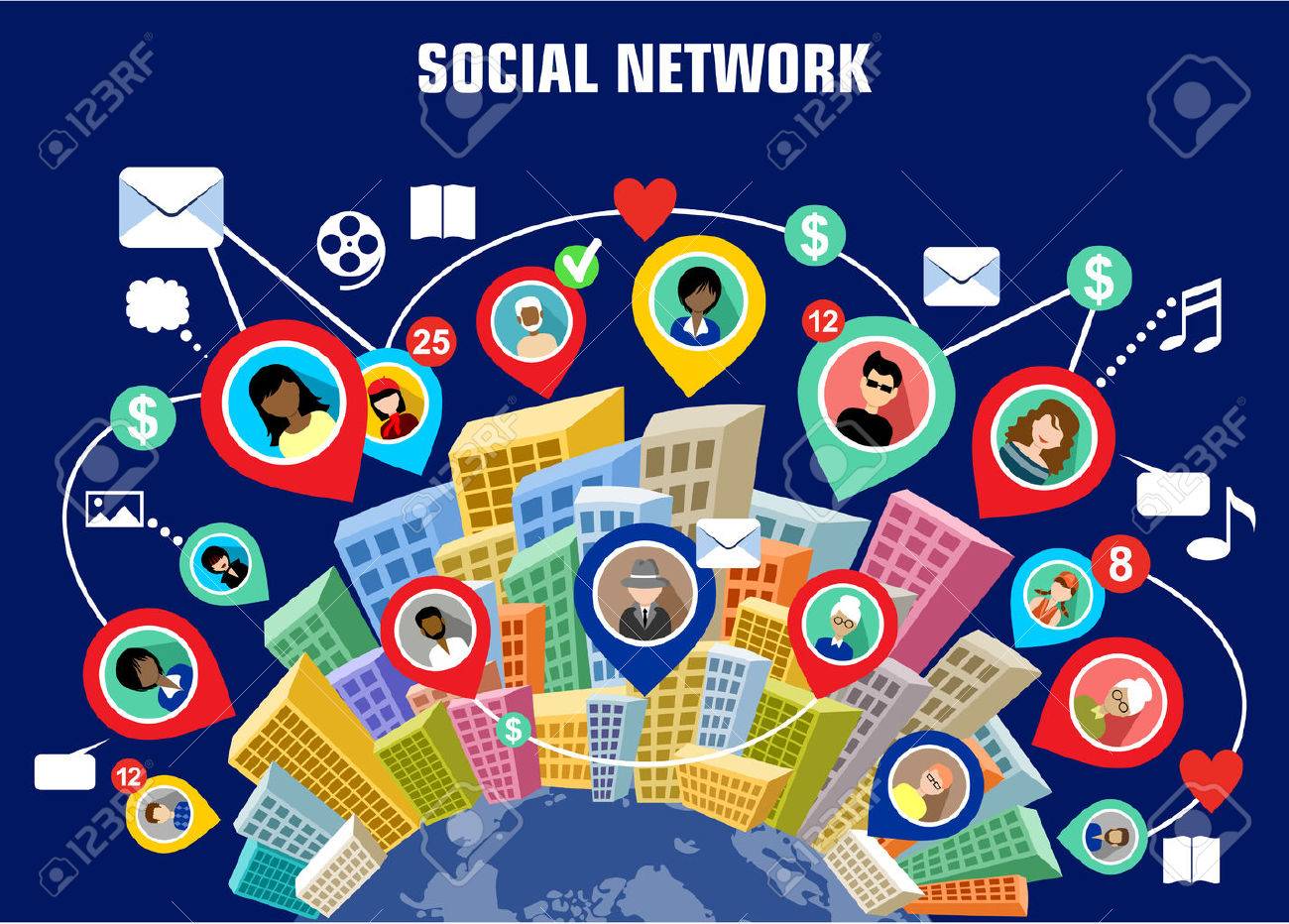
A social network is a social structure made up of a set of social actors (such as individuals or organizations), sets of dyadic ties, and other social interactions between actors. The social network perspective provides a set of methods for analyzing the structure of whole social entities as well as a variety of theories explaining the patterns observed in these structures.The study of these structures uses social network analysis to identify local and global patterns, locate influential entities, and examine network dynamics.
Social networks and the analysis of them is an inherently interdisciplinary academic field which emerged from social psychology, sociology, statistics, and graph theory. Georg Simmel authored early structural theories in sociology emphasizing the dynamics of triads and “web of group affiliations”. Jacob Moreno is credited with developing the first sociograms in the 1930s to study interpersonal relationships. These approaches were mathematically formalized in the 1950s and theories and methods of social networks became pervasive in the social and behavioral sciences by the 1980s.Social network analysis is now one of the major paradigms in contemporary sociology, and is also employed in a number of other social and formal sciences. Together with other complex networks, it forms part of the nascent field of network science.
Google cloud platform
Google Cloud Platform (GCP), offered by Google, is a suite of cloud computing services that runs on the same infrastructure that Google uses internally for its end-user products, such as Google Search and YouTube.Alongside a set of management tools, it provides a series of modular cloud services including computing, data storage, data analytics and machine learning.[ Registration requires a credit card or bank account details.[
Google Cloud Platform provides Infrastructure as a service, Platform as a service, and Serverless computing environments.
THE END!!!!!!!!!!!!!!!!!!!!!!!!!!!!!!!!!!!!!!!!!!!!!!!!!!!


 internet of things